Privacy in a Commercial Office: Designing for Focus, Comfort and Choice
written by OLG
Privacy in the contemporary commercial office is no longer about retreating behind walls. It is about enabling choice, supporting moments of deep focus, confidential conversation and energetic collaboration within a shared environment. Within the workspace, commercial furniture instigates a design-led opportunity: one that blends spatial planning, material intelligence and product strategy to deliver measurable workplace value.
Acoustic privacy: designing for how sound behaves
In open and hybrid workplaces, privacy challenges most often arise from sound, specifically speech. People are less concerned about noise levels than they are about intelligibility: overhearing conversations or feeling overheard themselves. While acoustic performance is supported by recognised Australian benchmarks, effective solutions are rarely about hitting a single target. Instead, they rely on shaping how sound moves, dissipates and is perceived across a space.
Successful offices layer these principles:
- Absorption to soften spaces and reduce reverberation.
- Interruption to break direct sound paths between teams.
- Distraction or cover through ambient sound where appropriate.
Furniture, screens, storage and soft finishes play a critical role here, often delivering acoustic benefit exactly where people are seated, rather than relying solely on architectural treatments.
Material choices: privacy is embedded in what you specify
Materials are one of the most powerful, and underestimated tools for privacy. Every surface either reflects sound, absorbs it, or signals how a space should be used.
Key material strategies include:
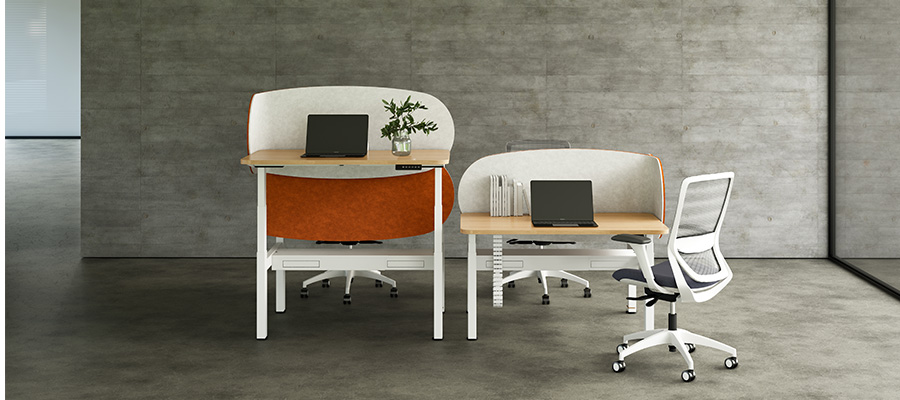
- Upholstered and felt-based products: PET felt panels, fabric-wrapped screens, acoustic screens, tiles and baffles provide high sound absorption while adding warmth and colour. These materials are especially effective when placed vertically and close to the user.
- Soft flooring solutions: carpet tiles and rugs reduce footfall noise and chair movement, supporting calmer work zones without visual enclosure.
- High-backed furniture and wrap-around forms: lounges, booths and banquettes create micro-environments that reduce sound spill while offering visual privacy.
- Timber, laminate and solid surfaces, used selectively: harder materials can still play a role when balanced with absorptive elements, contributing to durability and design contrast without overwhelming acoustics.
This material approach shifts the conversation from “acoustic add-ons” to material ecosystems, where finishes, furniture and form work together to shape behaviour and comfort.
Zoning: privacy as a spatial gradient, not a rulebook
The most effective offices don’t enforce silence, it’s intuitive. Zoning creates a clear gradient from active to quiet, allowing people to self-select the right environment for their task.
A privacy-led zoning approach typically includes:
- Team neighbourhoods with semi-open collaboration, anchored by screens, shared storage or planters that act as visual and acoustic buffers.
- Focus zones located away from circulation paths, supported by high absorption and calmer material palettes.
- Confidential spaces such as meeting rooms, phone booths and pods for sensitive conversations, HR discussions and client calls.
- Social and activation zones deliberately positioned to attract and enable noise, café settings, informal lounges and touchdown areas that pull energy away from focus spaces.
- Transition zones (lockers, print hubs, storage walls) that absorb movement and act as spatial separators rather than dead space.
Furniture is often the defining tool in these zones, enabling flexibility and future change without structural intervention.
Why privacy matters for partners
Privacy supports wellbeing, productivity and trust, but it also elevates perceived quality. When an office feels calm, intentional and supportive, the value of good design becomes tangible. For OLG Office privacy is not a constraint, it’s a design advantage, delivered through thoughtful specification and spatial intelligence of acoustics and furniture placement.
Click to download a printable PDF.