
What is NRC, and Why the Detail Matters in AcoustIQ Panel Selection.
In today’s workplace fitouts, acoustic performance is no longer a “nice to have.” It plays a direct role in focus, productivity, wellbeing, and ultimately how a space performs day to day.
Yet one of the most misunderstood (and frequently misrepresented), metrics in acoustics is the Noise Reduction Coefficient (NRC). High NRC values are frequently promoted as proof of performance. But without context, these numbers can be misleading, creating a false sense of confidence in how a product will actually perform once installed.
To make informed decisions, it’s essential to understand what NRC really represents, and more importantly, what it doesn’t.
What is NRC?
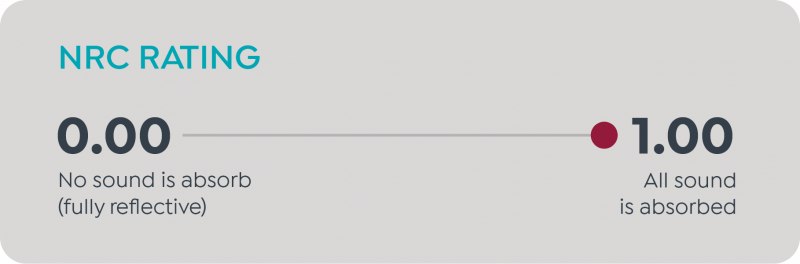
NRC (Noise Reduction Coefficient) is a single-number rating that indicates how much sound a material absorbs.
It ranges from 0.00 to 1.00:
For example:
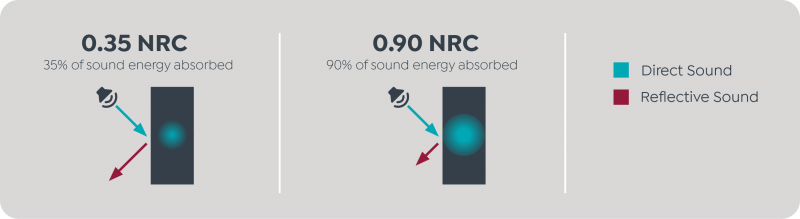
At first glance, this seems straightforward. But there’s a critical nuance often overlooked:
NRC is not an inherent property of the panel alone. NRC is a System Rating, Not Just a Product Rating
The acoustic performance of a panel depends heavily on how it is installed. Factors such as thickness, mounting method, backing materials, and especially the presence of an air gap can dramatically change the result.
This means two identical panels can achieve very different NRC ratings depending entirely on their installation configuration.
In practice, a high NRC value may reflect not just the material itself, but the test conditions used to achieve it.
The Air Gap Reality
One of the biggest influences on NRC is the air gap behind a panel.
In laboratory conditions, very high NRC values can be achieved by installing panels with large rear cavities, often 150–200mm or more. While technically valid, this setup rarely reflects real-world conditions.
In most commercial fitouts:
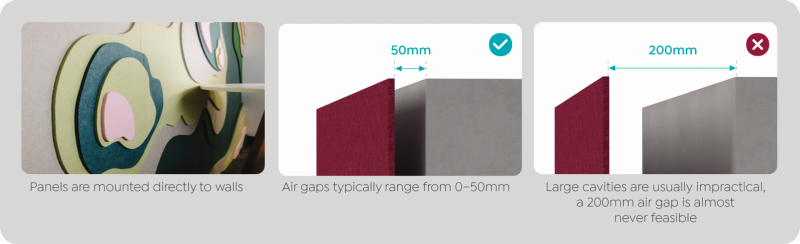
Despite this, some products are marketed using NRC results achieved with these large air gaps, without clearly disclosing the setup.
The result? Expectations that don’t match reality.
Why “NRC Without an Air Gap” Matters
A more meaningful starting point when evaluating acoustic panels is the baseline performance,
the NRC of the panel with no air gap.
This reveals:
- The inherent acoustic capability of the material
- The performance you can expect in space-constrained applications
- A realistic benchmark for comparison
Any air gap or backing should then be understood as a performance enhancement, not a hidden requirement.
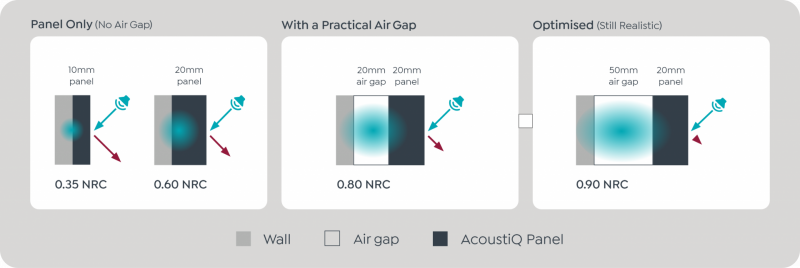
These examples show that strong performance is achievable, but through intentional design, not just product selection.
In contrast, some published results rely on unrealistic conditions. A 12mm PET panel tested with a 200mm cavity may achieve an impressive NRC in a lab, but without that cavity, installed performance drops significantly.
The NRC claim may be technically correct but only if a 200mm cavity can be constructed behind the panel.
The Key Point
An NRC number on its own is not enough.
What truly matters is understanding:
- Panel thickness
- Whether an air gap is used
- The size of that air gap
- Any additional backing
When these variables are disclosed, NRC becomes a reliable design tool. Without them, it becomes little more than a marketing figure.
For Those Wanting a Deeper Technical Understanding
The concepts above explain why NRC can be misleading. The following section explains how NRC is actually measured, and why test conditions have such a strong influence on the result.
How NRC is Calculated
NRC values are determined through controlled laboratory testing using international standards such as ASTM C423 and ISO 354.
These are not theoretical values, they are measured results. But importantly, they are measured under very specific conditions.
The Reverberation Room Test
Testing is conducted in a reverberation chamber designed to create a diffuse sound field, where sound energy arrives from all directions. The process involves:
-
- Generating broadband noise in the room
- Switching the sound off
- Measuring the sound decay rate (RT60)
This is done twice:
With the room empty
- With the test sample installed
- The difference between these measurements determines how much sound the sample absorbs.
The Frequencies Behind NRC
NRC is calculated as an average of absorption values at four mid-frequency octave bands:
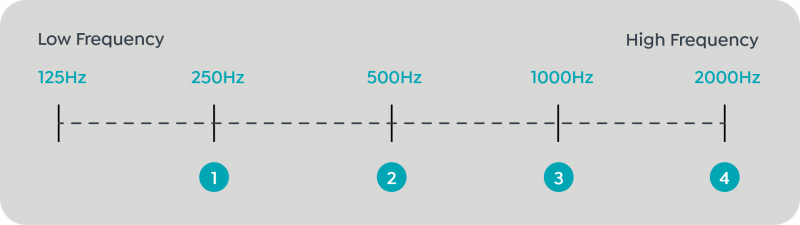

(rounded to the nearest 0.05)
This means:
- It focuses on speech-relevant frequencies
- It does not represent low-frequency performance
- It is an average from a laboratory result, not a full acoustic profile within a specific real world installation outcome.
Why Mounting Conditions Matter So Much
From an acoustic physics perspective, mounting plays a critical role. The method, Air gap presence and size and Backing materials.
At rigid surfaces (like walls), sound particle velocity is near zero. By introducing an air gap, the absorber is positioned where particle velocity is higher making it more effective.
This is why:
- Even a small air gap can significantly improve absorption
- Larger air gaps can dramatically inflate NRC results in testing
The same material can therefore produce very different outcomes depending purely on how it is mounted.
The Critical Takeaway
An NRC rating is not just about the material. It is the result of a system that includes:
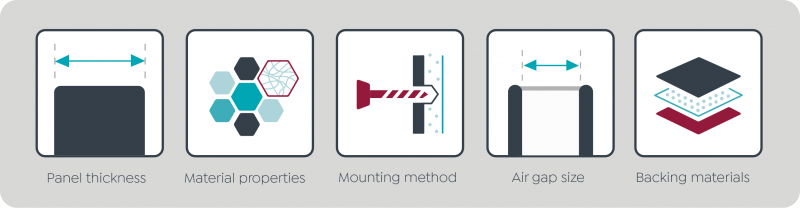
Without this context, an NRC value is incomplete, and potentially misleading.
Why Transparency Matters
For NRC to be a meaningful metric, it must be presented transparently.
At a minimum, suppliers should clearly state:
- Whether an air gap was used
- The size of that air gap
- Any backing materials included
Without this information, fair comparison is impossible, and real-world performance is left to guesswork.
A well-specified acoustic solution isn’t just about selecting a product. It’s about understanding the system behind the number and designing for the conditions that actually exist on site.