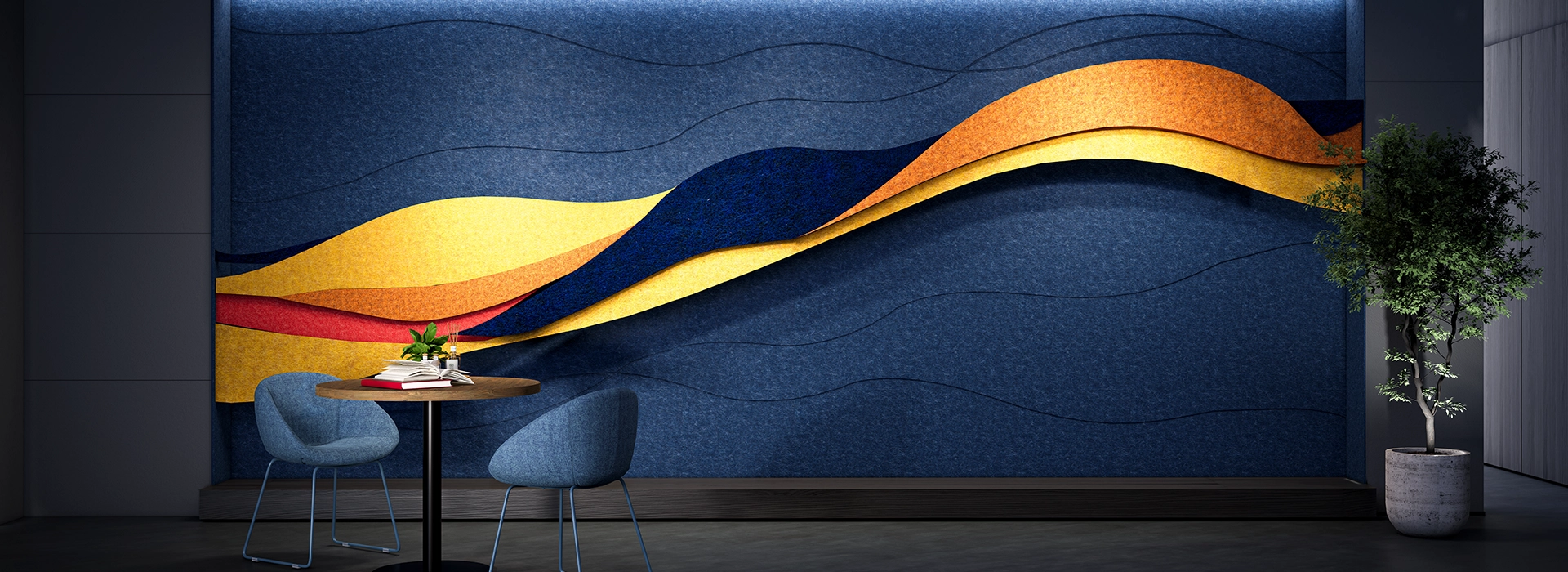
AcoustIQ by OLG acoustic panels: Group 1 fire rated, recycled PET and independently tested.

What AcoustIQ is, how it performs, what its Group 1 fire rating means, and why the best acoustic outcomes start with an expert conversation.
Key facts
- Recycled PET: 100% PET with a minimum of 80% recycled content, around 120 recycled 600mL bottles in every square metre.
- Australian Made: panels, screens, clouds and partitions cut and fabricated to order by OLG carry the licensed Australian Made logo.
- Group 1 fire rating under AS 5637.1:2015
- Tested sound absorption from NRC 0.40 up to NRC 0.90 and Class A.
- 44 colours, cut to order within two to three weeks, with a 10 year warranty.
Noise is one of the most common complaints in any shared space. In open-plan offices, classrooms, clinics, cafés and meeting rooms, hard surfaces bounce sound around until conversations blur, concentration drops and people start reaching for headphones. Good acoustic treatment fixes that, and it does it quietly, in the background, every day.
AcoustIQ is OLG’s acoustic panel range. This article covers what AcoustIQ is made of, how it performs in independent testing, what its Group 1 fire result means for your project, the products in the range, and why working with someone who understands acoustics makes the difference between a room that looks treated and a room that sounds right.
What is AcoustIQ.
AcoustIQ by OLG is a range of acoustic panels, ceiling solutions, screens and partitions made from polyester (PET) fibre. It is designed for architects, designers, fitout partners and end users who want acoustic performance without giving up on colour, form or sustainability.
AcoustIQ at a glance
| Specification | AcoustIQ |
|---|---|
| Material | 100% PET, minimum 80% recycled content |
| Recycled bottles | Around 120 x 600mL bottles per m²; more than 360 per 1220 x 2440mm sheet (10mm) |
| Thicknesses | 10mm, 20mm and 30mm |
| Mass | 2000, 3800 and 5800 g/m² (10/20/30mm), ±7.5% |
| Sheet sizes | 2440mm x 1220mm, 2750mm x 1200mm, 2750mm x 1830mm |
| Colours | 44 standard colours across five groups |
| Fire | Fire Group 1 (AS 5637.1:2015), 10mm adhesive fixed |
| Indoor air quality | Formaldehyde free, VOC < 0.02 mg/m²/hr (ASTM D5116) |
| Lead time | Cut to order within two to three weeks |
| Australian Made | Licensed for products cut and fabricated to order by OLG |
| Warranty | 10 years |
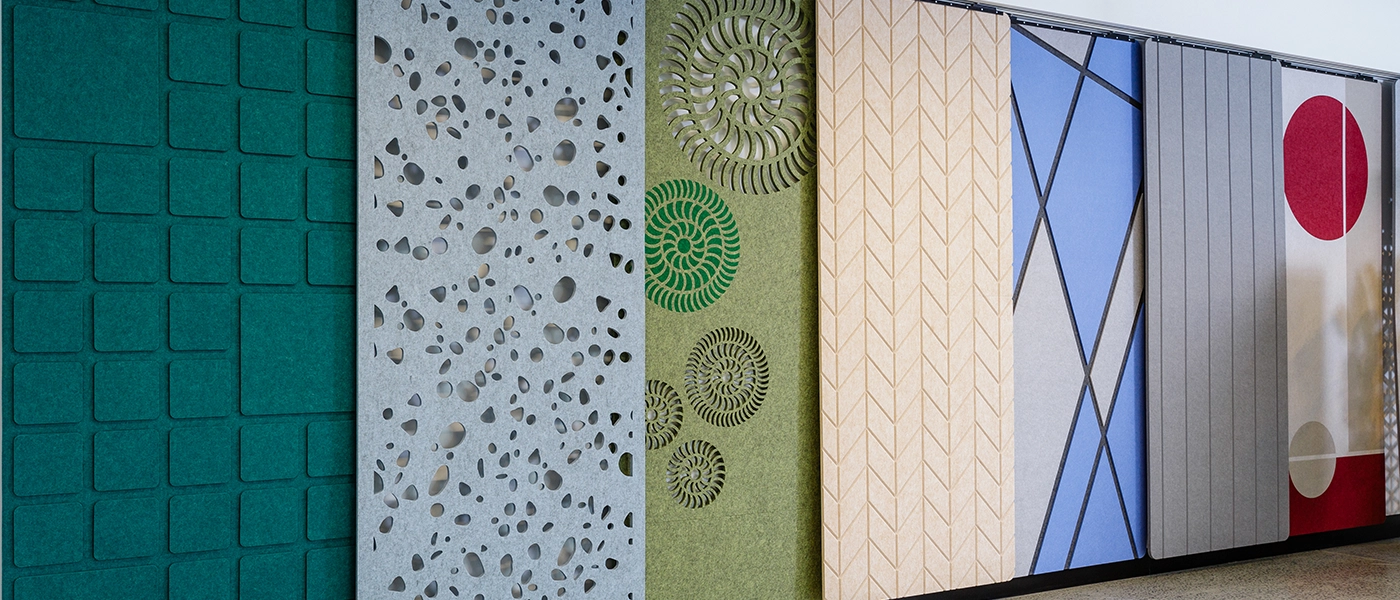
The 44 colours sit in five groups, Marble, Forest, Neutrals, Jewel, and Bright & Bold, so you can go quiet and tonal or make the acoustic treatment the feature of the room.
Around 120 bottles in every square metre. Every square metre of 10mm AcoustIQ contains the equivalent of around 120 recycled 600mL plastic bottles. A full 1220 x 2440mm sheet holds approximately 4.4kg of post-consumer recycled PET, more than 360 bottles.
Bottle figures are based on 10mm board and an average 600mL PET bottle weight of around 12g.
Australian Made, and what that covers
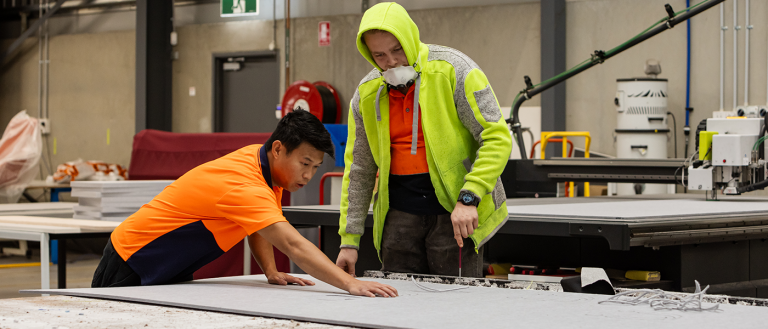
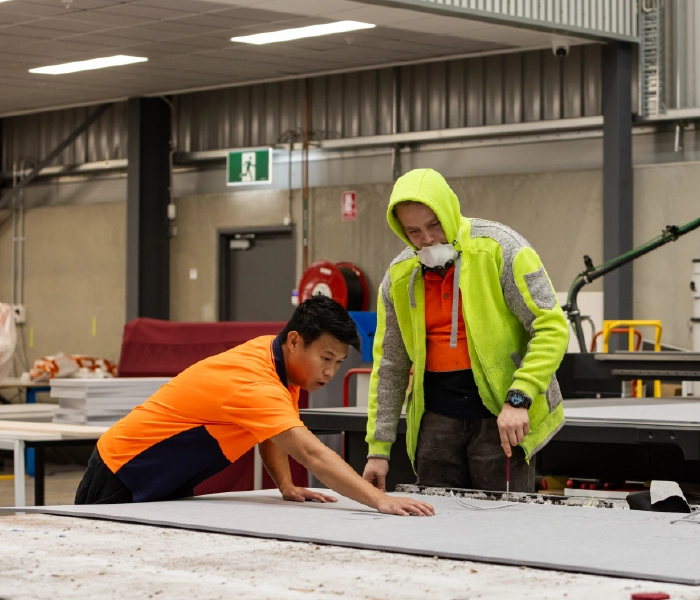
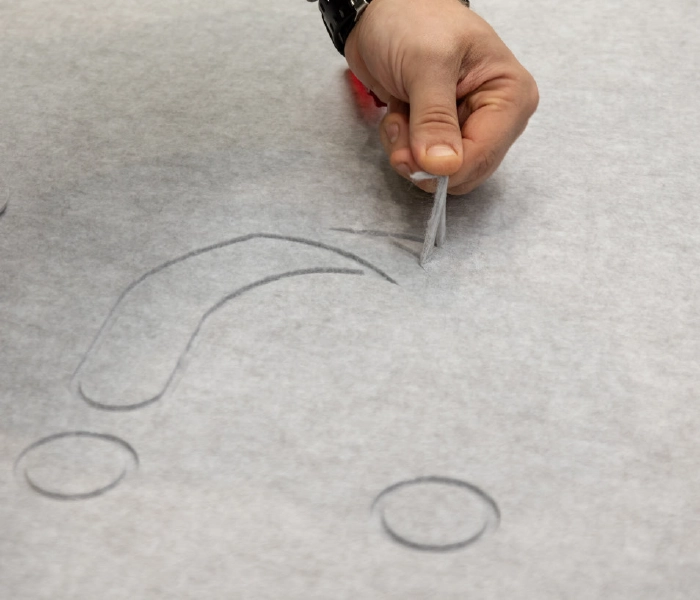
When OLG cuts and fabricates AcoustIQ to order, sizing wall panels, routing V-Line grooves, shaping clouds, laminating dual-colour boards or building screens and partitions, the work is done here in Australia by our team, and those products are licensed to carry the Australian Made logo.
If your project needs Australian Made products, tell us at enquiry and we’ll confirm which items qualify.
How AcoustIQ helps a space.
- Speech is clearer. People hear each other the first time, in meetings, classrooms and on calls.
- Background noise drops. Less echo means less build-up, so the room stops getting louder as people raise their voices to be heard.
- Focus improves. Fewer distractions in open-plan areas means better concentration and less fatigue across the day.
- Privacy improves. Absorption, combined with screens and partitions, helps keep conversations where they belong.
- Design stays in control. Panels, clouds, tiles and screens add colour, shape and texture while doing the acoustic work.
Understanding NRC and absorption class.
Acoustic panels are compared using a few standard measures. Knowing what they mean helps you compare products on an equal footing.
- NRC (Noise Reduction Coefficient). A single number from 0 to 1 showing how much sound a material absorbs across the main speech frequencies. 0 reflects everything, 1 absorbs everything. An NRC of 0.70 means roughly 70% of that sound energy is absorbed.
- αw (weighted sound absorption coefficient). A single-number rating under ISO 11654, weighted against a reference curve. It is often lower than NRC because it penalises weak performance at some frequencies.
- Absorption Class (A to E). The ISO 11654 class that sits with αw. Class A is the highest absorption, Class E the lowest.
What each class means
| Class | αw range | What it means |
|---|---|---|
| A | 0.90 to 1.00 | Exceptional. Absorbs nearly all the sound that reaches it. Usually suspended ceilings with a deep air gap. |
| B | 0.80 to 0.85 | Very high. A great choice where speech clarity matters most, such as meeting rooms and classrooms. |
| C | 0.60 to 0.75 | High. A strong all-round result for busy, open spaces. |
| D | 0.30 to 0.55 | Good. Solid, practical absorption, and where most direct-fixed PET wall panels sit. Ideal for treating large wall areas. |
| E | 0.15 to 0.25 | Light. A small improvement to a room. |
| Not classified | 0.00 to 0.10 | Reflective surfaces such as glass, concrete and plasterboard. |
Class D is a good result. It means a panel absorbs a solid share of the sound across speech frequencies, and it is the class most direct-fixed PET wall panels achieve. From there, the class climbs as you add an air gap or move treatment to the ceiling.
The mounting matters as much as the panel. The same panel performs differently when it is fixed directly to a wall, stood off the wall with an air gap behind it, or suspended below a ceiling. An air gap lets the panel work on lower frequencies too, which is why the gap is always part of a credible test result.
How AcoustIQ performs.
AcoustIQ Sonus is tested for sound absorption by ARAI NVH-ANDC to ASTM C423-23 and ISO 354:2003 standard.
| Product and mounting | NRC | αw | Class |
|---|---|---|---|
| 10mm panel, direct fix | 0.40 | 0.30 | D |
| 10mm panel, 20mm air gap | 0.60 | 0.40 | D |
| 20mm panel, direct fix | 0.70 | 0.50 | D |
| 20mm V-Line panel, direct fix | 0.70 | 0.50 | D |
| 20mm panel, 20mm air gap | 0.75 | 0.65 | C |
| 30mm panel, direct fix | 0.85 | 0.70 | C |
| 20mm panel, 50mm air gap | 0.85 | 0.80 | B |
| 20mm ceiling tile, 300mm air gap | 0.90 | 0.90 | A |
What the numbers tell you
- Thickness lifts performance. Direct fixed, moving from 10mm to 20mm to 30mm takes NRC from 0.40 to 0.70 to 0.85.
- An air gap is the cheapest upgrade. The same 20mm panel moves from NRC 0.70 direct fixed to 0.85 with a 50mm gap, and from Class D to Class B.
- Ceilings do the heavy lifting. Suspended 300mm below the soffit, the 20mm ceiling tile reaches NRC 0.90 and Class A, the top absorption class.
- Grooves don’t cost you performance. The 20mm V-Line panel matches the plain 20mm panel at NRC 0.70.
Group 1 fire rating, and why it matters.
Wall and ceiling linings in Australian buildings must meet the fire hazard requirements of the National Construction Code (NCC). Linings are given a Group number from 1 to 4 based on how they behave in a full-scale room fire test. Group 1 is the best result: the material does not reach flashover in the test, so it can be used across the widest range of building classes and locations.
AcoustIQ achieved Group 1 when tested by Ignis Labs, a NATA accredited laboratory (accreditation 20534, ISO/IEC 17025), to AS ISO 9705:2003 (R2016) and reported to AS 5637.1:2015. The test also recorded a smoke growth rate index (SMOGRA-RC) of 1.11, far below the limit of 100 the NCC applies in buildings without sprinklers.
| Product | What it does |
|---|---|
| Sonus Panels | The core wall panel in 10mm, 20mm and 30mm, for direct fix or air gap mounting. |
| V-Line | Grooved panels that add texture and pattern with the same performance as plain Sonus 20mm. |
| Contour | Shaped panels for feature walls and expressive acoustic treatment. |
| Breeze partitions | Freestanding partitions that divide space and absorb sound at the same time. Available in dual colour. |
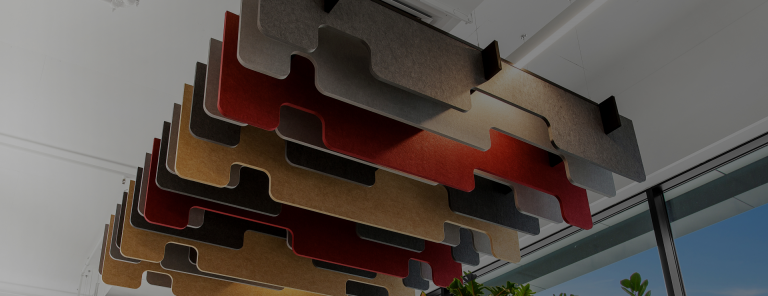
| Nimbus sound clouds | Suspended ceiling panels that treat large and high-ceiling spaces from above. |
| Trellis ceiling tiles | Acoustic ceiling tiles, Class A capable with a suitable plenum. |
| Zen screens | Desk and floor screens for focus and visual privacy in open-plan areas. Available in dual colour. |
| Mosaic tiles | Modular acoustic tiles for patterned, colour-led wall designs. |
| Custom printed panels | Your artwork, wayfinding or brand graphics printed onto acoustic panels. |
Acoustics that add to the design.
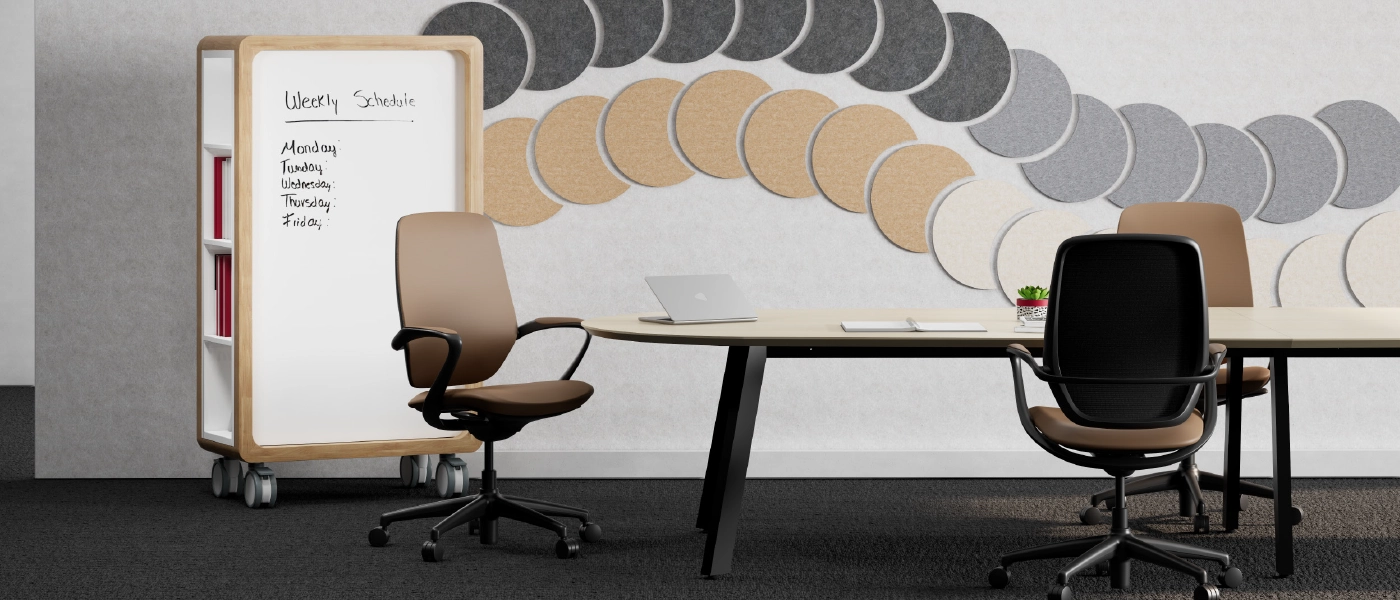
Stick a grey rectangle on a wall and a room will sound a little better. It will also look like someone fixed a problem after the fitout was finished. That is the old way of doing acoustics: a slab, chosen late, hidden where possible.
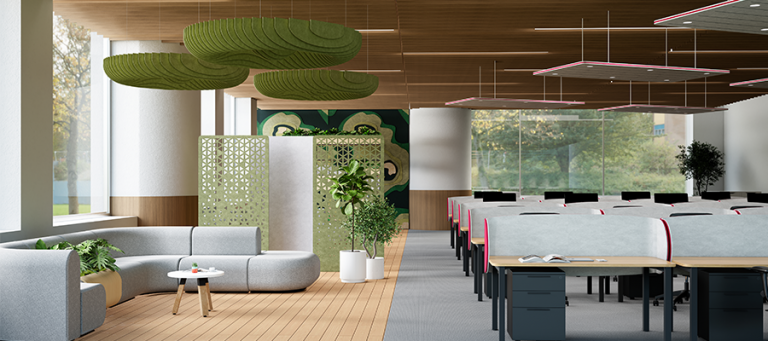
The better way treats acoustic surfaces as a design material from day one, alongside timber, tile and lighting. The same square metres of absorption can become a feature wall people photograph, a ceiling that gives a large space its character, or a pattern that guides people through a building. The room sounds better, and it looks like it was meant to.
Colour with intent
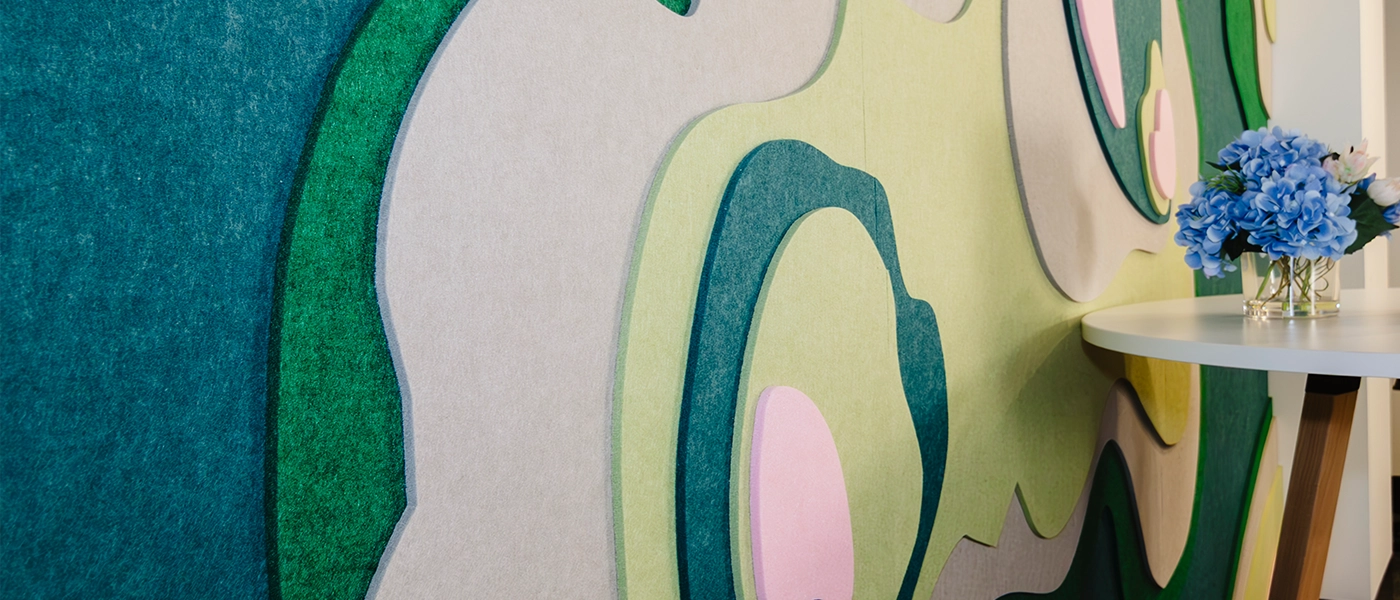
AcoustIQ’s 44 colours give designers a full palette, not a token choice. Tonal Neutrals and Marble shades let panels sit quietly in the architecture. Forest and Jewel tones bring warmth and depth. Bright & Bold turns a wall into a statement. Colour can also do a job: zone a floor into neighbourhoods, mark a meeting space or lead people to reception.
Form, pattern and shadow
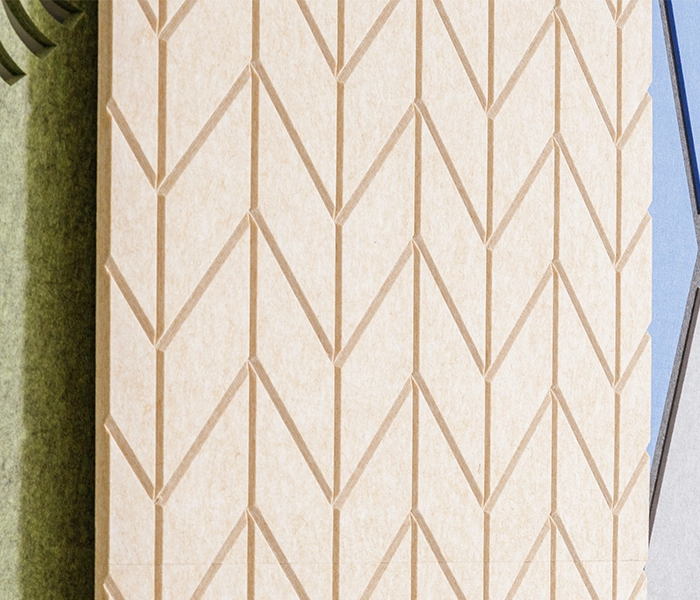
Flat panels are only the starting point. V-Line grooves catch the light and add rhythm. Contour shapes and Mosaic tiles break up a wall into pattern. Layering panels at different depths creates shadow lines and texture, and here design and performance work together: standing a 20mm panel off the wall by 50mm lifts it from NRC 0.70 to 0.85.
Look up
The ceiling is the biggest surface in most rooms and the most overlooked. Nimbus sound clouds hung at varied heights add sculpture overhead, and Trellis ceiling tiles bring order and pattern to an exposed soffit. Suspended with a 300mm air gap, the 20mm tile reaches NRC 0.90 and Class A, so the boldest design move is also the hardest working one.
Make it yours
Custom printed panels turn acoustic treatment into artwork. Brand graphics, a local landscape, a mural by a commissioned artist or wayfinding all work, printed straight onto the panel that is absorbing sound behind it.
Shape the space
Breeze partitions and Zen screens give an open floor structure without building walls. They define zones, add privacy and bring colour to the middle of a room, not just its edges.
Two colours, one panel
AcoustIQ screens and Breeze partitions can be made in two colours. OLG laminates two 10mm AcoustIQ boards together here in Australia to make a 20mm panel, and because each board can be a different colour, a screen can show one colour on each face with a two-tone line along its edge.
Most PET screens are cut from single-colour 12mm or 24mm board, so one colour is all you get. Dual colour opens up a detail people notice: the client’s brand colour facing the corridor and a calm neutral facing the desk, a bright accent against a quiet floor, or a contrast edge that picks up the joinery. Choose any two of the 44 standard colours.
Questions to ask at concept stage
- How should this space feel when it is full of people?
- Where will people look first, and what should they see?
- Which surfaces can do more than one job?
- How can the acoustic treatment tell the client’s story?
This is where the right support counts. Design-led acoustics needs two things working together: the designer’s vision and someone who knows how sound behaves in a room. The AcoustIQ team works with you on layout, coverage, colour and mounting, with samples, renders and CAD and Revit files, so the feature that wins the client over is also the one that makes the room work.
Why working with an acoustics expert matters.
An NRC figure tells you how a panel performs in a test chamber. It does not tell you how your room will sound. That depends on the room itself, and getting it right means asking the right questions early.
What an expert looks at
- The room. Volume, ceiling height and the amount of glass, concrete and hard flooring all change how much treatment a space needs.
- The use. A boardroom, a classroom, a call centre and a café each need different targets for echo and speech clarity.
- How much and where. Coverage and placement count as much as the product. Ceilings, first reflection points and the walls behind people talking are where treatment works hardest.
- The mounting. Choosing between direct fix, air gap and suspension can lift a result by one or two absorption classes for little extra cost.
- Compliance. Matching the fire-tested system, adhesive and fixing to the building class and location, so certification goes smoothly.
- Delivery. Lead times, cut-to-order sizes and installation details planned upfront, not fixed on site.
How OLG supports your project
OLG works with architects, specifiers, fitout partners and resellers from enquiry to installation. When you specify AcoustIQ, you get:
- Product advice on the right panel, thickness, mounting and coverage for the space.
- Free samples on request, so you can see and feel the colours and finishes.
- CAD files across the range, Revit files on a growing number of products, and renders.
- Full specification and certification packs, including fire and acoustic test data.
- A response to specifier enquiries within 48 hours.
Quick answers.
What is AcoustIQ made from?
100% PET (polyester) fibre with a minimum of 80% recycled content. It is formaldehyde free.
How many recycled bottles are in AcoustIQ?
Every square metre of 10mm AcoustIQ contains the equivalent of around 120 recycled 600mL plastic bottles. A full 1220 x 2440mm sheet holds approximately 4.4kg of post-consumer recycled PET, more than 360 bottles.
Which AcoustIQ products are Australian Made?
AcoustIQ panels, screens, clouds and partitions that OLG cuts and fabricates to order in Australia are licensed to carry the Australian Made logo. The AcoustIQ team can confirm the products for your project.
What NRC does AcoustIQ achieve?
From NRC 0.40 (10mm direct fixed) up to NRC 0.90 and Class A (20mm ceiling tile with a 300mm air gap). The 30mm panel reaches NRC 0.85 direct fixed.
Is AcoustIQ fire rated?
Yes. AcoustIQ 10mm, adhesive fixed with TEC 7 Extreme Xtack, achieved Group 1 under AS 5637.1:2015, with a SMOGRA-RC of 1.11.
What does Class D mean for an acoustic panel?
Class D means good, practical sound absorption, with an αw of 0.30 to 0.55. Most direct-fixed PET wall panels sit in Class D. AcoustIQ moves up to Class C, B or A with an air gap or as a suspended ceiling.
Can AcoustIQ screens and partitions be two colours?
Yes. OLG laminates two 10mm AcoustIQ boards into a 20mm panel in Australia, so Zen screens and Breeze partitions can have a different colour on each face, chosen from the 44 standard colours.
Can acoustic panels be part of the interior design?
Yes. AcoustIQ comes in 44 colours, grooved and shaped panels, suspended clouds, screens and custom printed panels, so acoustic treatment can be a feature wall, a ceiling installation or artwork, not just a panel on a wall.
What NRC should acoustic panels have for an open plan office?
As a general guide, look for wall panels of NRC 0.70 or higher in open plan areas, and add ceiling treatment where you can, because ceilings cover the largest area. The right figure depends on room size, finishes and how much surface you can treat, so ask for an acoustic assessment before you specify.
How many colours are there?
44 standard colours in five groups: Marble, Forest, Neutrals, Jewel, and Bright & Bold.
How long does AcoustIQ take?
Panels are cut to order within two to three weeks.
What warranty does AcoustIQ carry?
10 years.
Planning a space that needs to sound better.
Talk to the AcoustIQ team about your project, request samples, or ask for the full specification and certification pack.
Last Updated: